Range states
Many of the issues facing the range states affect the entire region rather than individual countries, hence IGCP’s emphasis on regional collaboration.
Population pressure
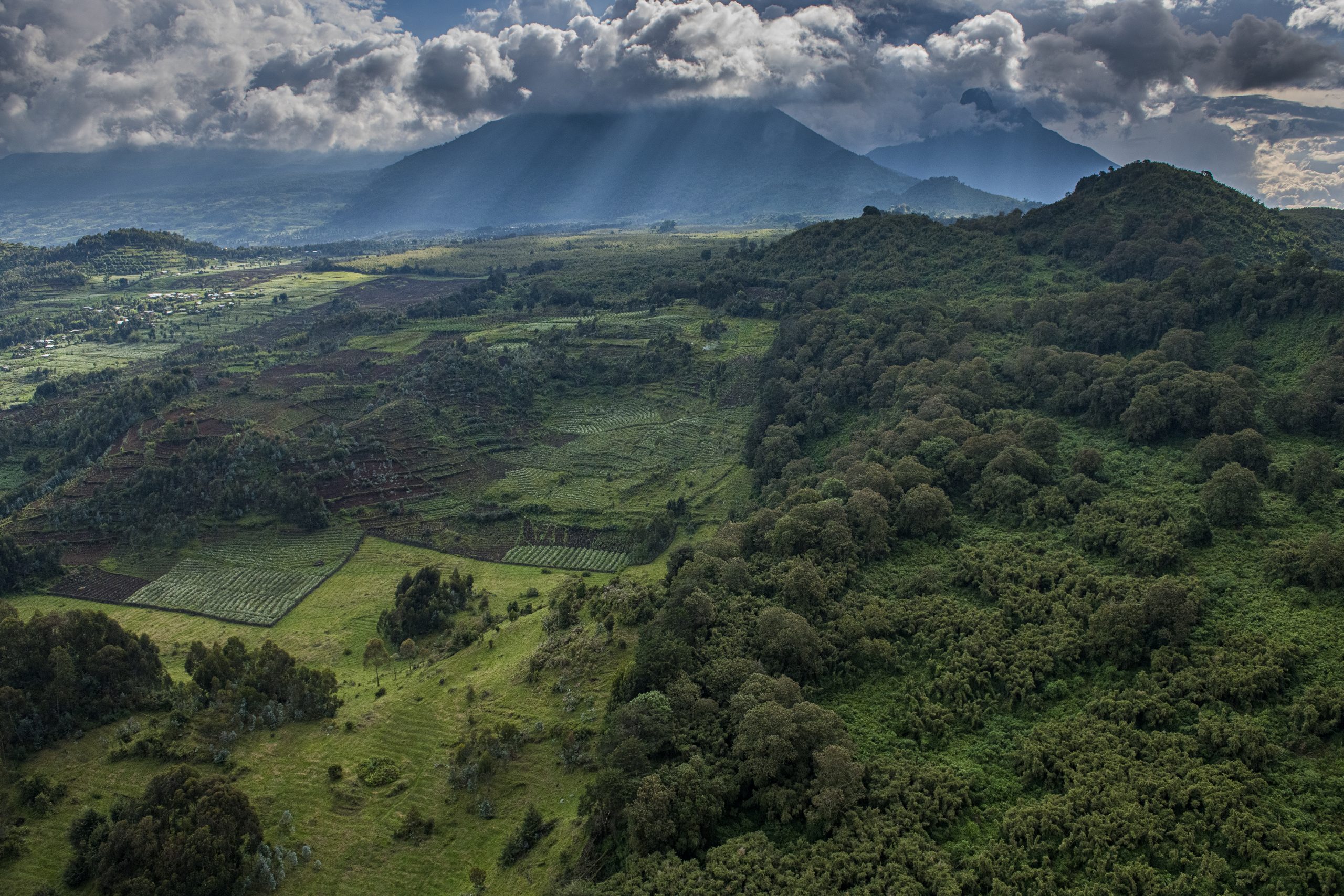
The Central Albertine Rift area is one of the most densely populated regions of Africa. Every square km contains an average of 420 people. In Rwanda, Uganda and eastern DRC, 91% of the population practise subsistence farming, which requires them to convert the forest into agricultural land. Over 96% of these people rely on firewood, often harvested unsustainably, as the main energy supply. Forested parks are often the last remaining source of fuel.
Conflict zone
The region where mountain gorillas live has been plagued by instability for decades, but the crisis reached a new peak in 1990. Since its inception, IGCP has been forced to operate against a background of violent conflict, human tragedy and economic disintegration.
The 1990-94 war and genocide in Rwanda resulted in massive human population movements throughout the region. At the end of 1996, the dismantling of refugee camps in Congo and Tanzania prompted the forced and rapid repatriation of over two million people to Rwanda. After the Alliance of Democratic Forces for the Liberation of Congo-Zaire (ADFL) assumed power and formed a new government in 1996, Zaire was renamed the Democratic Republic of Congo. In 1998, the ADFL split and the Rassemblement Congolais pour la Démocratie (RCD) was formed. Other newly formed rebel groups joined the power struggle. Uganda, Rwanda, Zimbabwe, Burundi, Namibia and Angola have all been actively involved in the war. Initiatives such as the Lusaka Peace Accords, signed in 1998, the Inter Congolese Dialogue held in Sun City, South Africa and the peace process launched in Pretoria, South Africa in 2002 have encouraged talks between the main protagonists in the conflict. On the ground, however, fighting continues to hamper rehabilitation and reconstruction efforts.
Illegal activities
Law enforcement is one of the first casualties of war. On occasions, illegal activities such as logging, poaching and mining have threatened to spiral out of control in some areas. The bushmeat trade has rocketed, fuelled by increased demand and easy access along logging roads into previously impenetrable forest.
Illegal coltan mining, whilst not yet directly affecting mountain gorilla habitat, is devastating other wildlife in the DRC. Coltan is the mineral source of tantalum, a rare metal used in the production of mobile phone and other electronics components.
Find out more about Gorillas
If you value the natural world, if you believe it should be conserved for its own sake as well as for humanity’s, then please lend your support.
- — Sir David Attenborough