Great apes of the world

Great apes are so called because of their size, but these magnificent animals are equally ‘great’ in a metaphorical sense.

The orang-utan Pongo pygmaeus, confined to the islands of Borneo and Sumatra, is Asia’s only surviving great ape. Mainly solitary and arboreal, it is the largest tree-dwelling primate. Large males can weigh 90 kilos (200 pounds) or more. Orang-utans are sparsely covered in long hair, which darkens with age and ranges in colour from bright orange to dark brown.

African great apes – chimpanzees and gorillas – are covered with short, coarse, black hair. Although they are accomplished climbers, they are equally at home on the ground. They usually move around on all fours, but will walk short distances on two legs.

Chimpanzees are mainly found in tropical rainforest, though some frequent savannah woodland. They usually live in loose groups of thirty or more individuals and are extremely vocal communicators. Adult chimpanzees stand about 1.2 metres (four feet) tall and weigh around 45 kilos (100 pounds). The bonobo, or pygmy chimpanzee Pan paniscus, is slightly smaller and more upright than the “common” chimpanzee (Pan troglodytes). Less comfortable on the ground, it is the most arboreal of Africa’s great apes and is confined to the left bank of the Congo River in the swampy forests of the Democratic Republic of Congo.

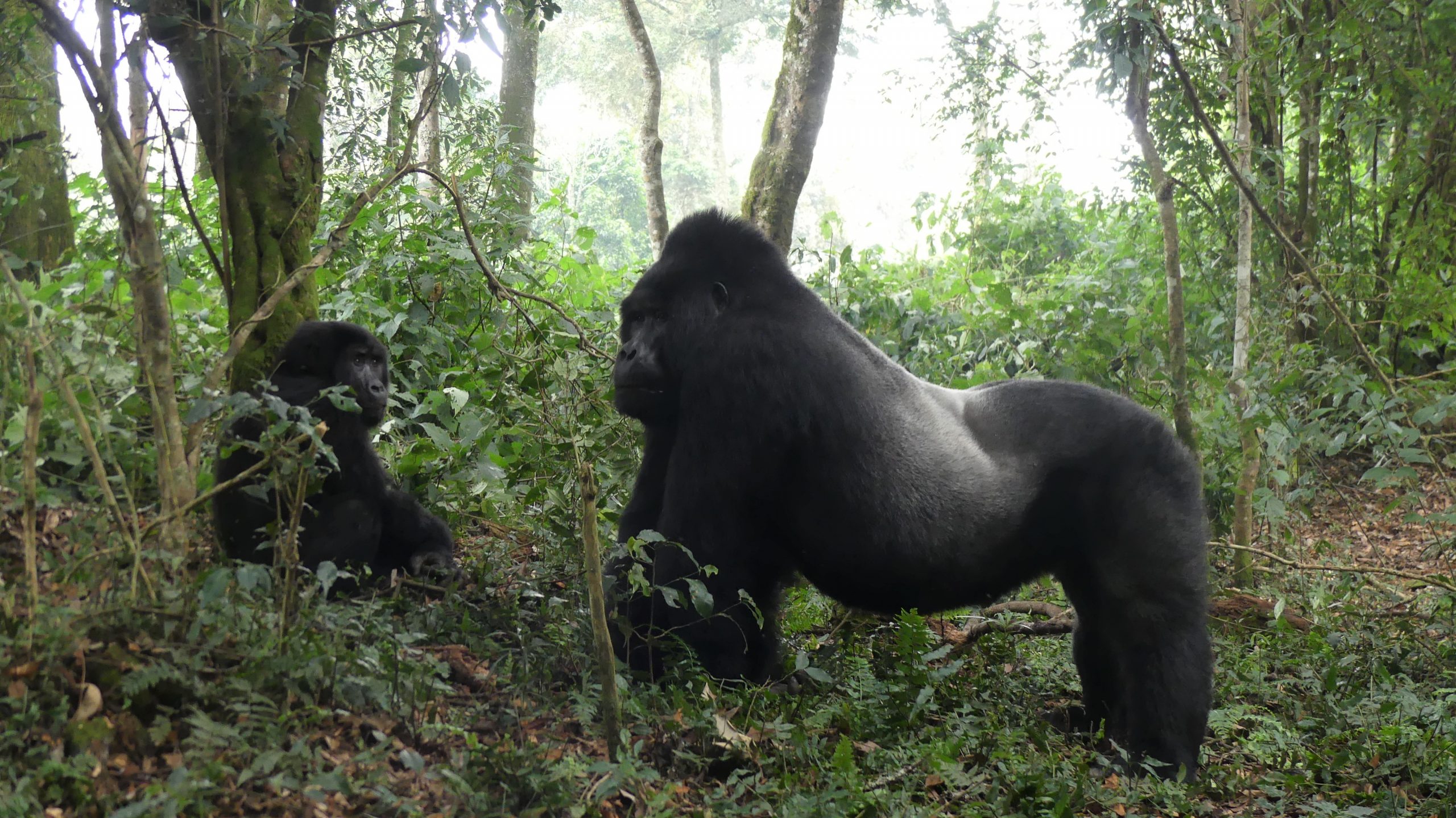
The gorilla is the largest of the great apes. An adult male can weigh over 180 kilos (400 pounds). When mature, males develop a silver-grey saddle, hence the name ’silverback’. Adult females weigh about 90 kilos (200 pounds). Lowland gorillas occur in Angola, Cameroon, Central African Republic, the Democratic Republic of Congo (DRC), Equatorial Guinea, Gabon, Nigeria and the Republic of Congo.

The western lowland gorilla Gorilla gorilla has an estimated population of 10,000. Although it is the most widespread gorilla, numbers are decreasing rapidly. Its population is currently threatened not only by deforestation and the bushmeat trade, but also by potentially devastating outbreaks of the Ebola virus. It lives in flexible social groupings and, in that respect, more closely resembles chimpanzees than other gorillas. It also has a broader diet and consumes a larger proportion of fruit. As with all apes, logging and the bushmeat trade have taken a heavy toll and led to severe fragmentation of the population. The eastern lowland gorilla (Gorilla beringei graueri), found only in eastern DRC, is less well known. Its population is thought not to exceed 7,000. By virtue of its location, it is highly vulnerable and has been severely affected by both war and illegal mining.

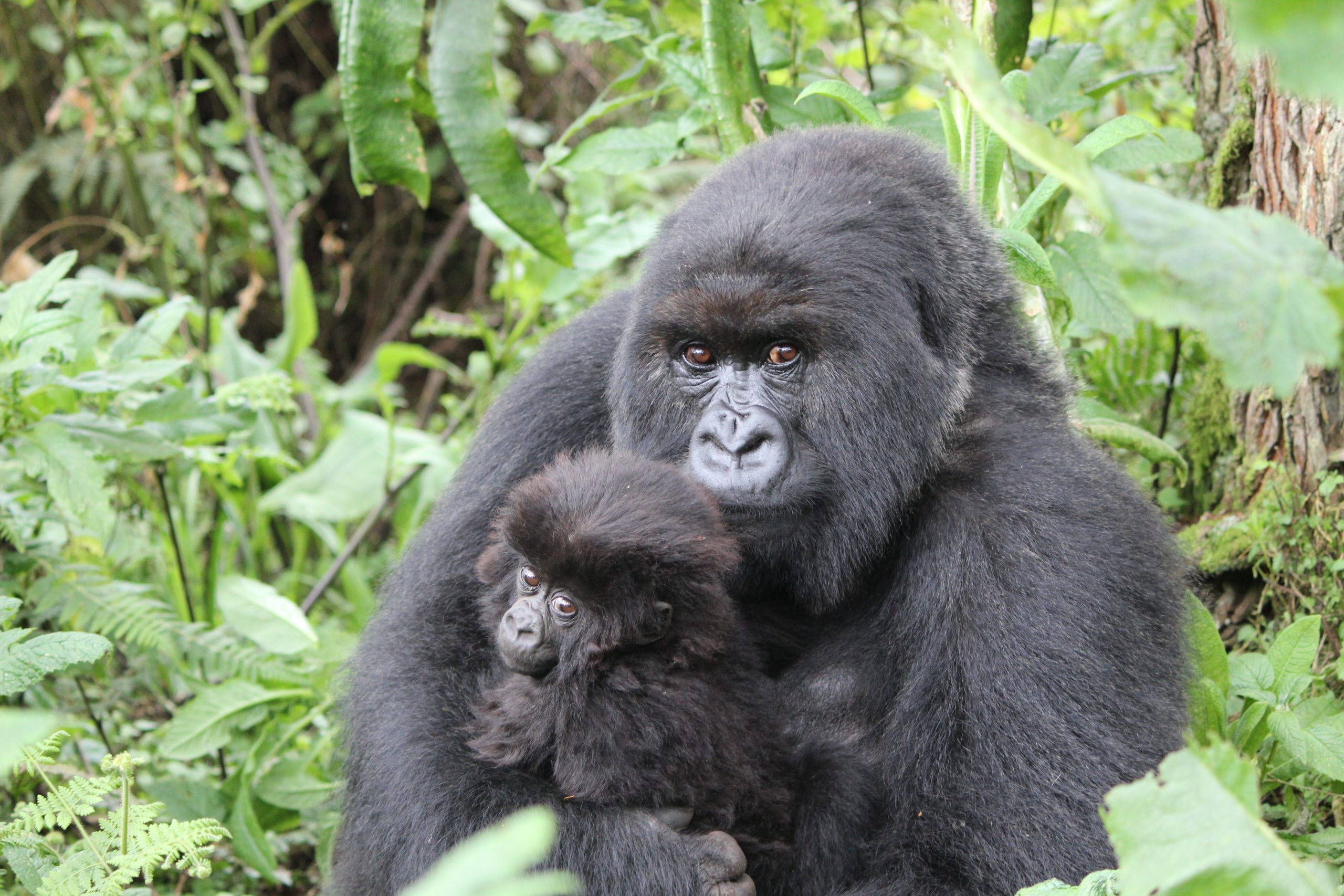
Mountain gorillas (Gorilla beringei beringei) are generally larger than their lowland counterparts. They are confined to two small, protected patches of afromontane forest in Uganda’s Bwindi Impenetrable National Park and the Virunga Volcano Region where Rwanda, Uganda and DRC meet. Along with the Cross River subspecies of the western lowland gorilla (Gorilla gorilla diehli), the mountain gorilla is one of the two most endangered apes in the world.

See IUCN Red Data Book for more information on the status of great apes.

great apes

Find out more about Gorillas

  • If you value the natural world, if you believe it should be conserved for its own sake as well as for humanity’s, then please lend your support.

  • — Sir David Attenborough
Latest news & posts
  • Caught in the Crossfire: Concern for the people and gorillas of Virunga National Park

    Caught in the Crossfire: Concern for the people and gorillas of Virunga National Park

    The mountain gorilla sector of Virunga National Park in the Democratic Republic of Congo is under siege after an infiltration by renegade soldiers last week. Above photo by LuAnne Cadd/ Virunga National Park. The...

    Read more
    Mikeno Sector becomes refuge for militia loyal to Bosco Ntaganda

    Mikeno Sector becomes refuge for militia loyal to Bosco Ntaganda

    We are sorry to report that the forests of Virunga National Park in Eastern DRC have become ground zero for the hunt for renegade general Bosco Ntaganda and troops loyal to him. Here is the report of the situation...

    Read more
    Buniga Forest Walk: Meet the Batwa then and now

    Buniga Forest Walk: Meet the Batwa then and now

    The Buniga Forest Walk is now open! Located in Nkuringo near Bwindi Impenetrable National Park in Uganda, this 1.5 km trail explores Buniga Forest, with its lush tree ferns and giant lobelia. The Walk is guided by...

    Read more
    Buniga Forest Walk: Involving the Batwa in conservation

    Buniga Forest Walk: Involving the Batwa in conservation

    If you are ever curious as to why conservation organizations like IGCP are working to collaborate with the Batwa people of the region, all you have to do is watch one of their members set a snare for wildlife with not...

    Read more
  • A New Silverback for IGCP: Augustin Kanyunyi Basabose

    A New Silverback for IGCP: Augustin Kanyunyi Basabose

    Augustin Kanyunyi Basabose, one of Africa’s leading experts on Great Apes, is now the Interim Director of the International Gorilla Conservation Programme (IGCP) – a coalition of the African Wildlife Foundation,...

    Read more
    World Water Day: Behind the scenes of a conservation water scheme

    World Water Day: Behind the scenes of a conservation water scheme

    A woman enters the Virunga Massif with her baby tied on her back. She's looking for a few jerricans of water to do the washing, cooking, and provide drinking water for her family. With limited choices, she enters the...

    Read more
    Renewed coordinated patrols to curb poaching in Virunga Massif

    Renewed coordinated patrols to curb poaching in Virunga Massif

    In the heart of the Virunga Massif, unhabituated mountain gorillas range. Unfortunately, poachers also range there, setting traps called snares for wildlife. In early February, one of those unhabituated mountain...

    Read more
    IGCP coalition celebrates 20th anniversary and launches effort to develop new strategy

    IGCP coalition celebrates 20th anniversary and launches effort to develop new strategy

    We are pleased to share the news that Eugène Rutagarama, IGCP Director since 2003, will soon lead a task force that will craft a new strategy for the organization. Dr. Augustin Basabose, currently Species...

    Read more