Frequently asked questions

How is IGCP funded?

IGCP is funded from a variety of donors, including bilateral agencies such as the US Agency for International Development, multilateral donors such as the World Bank and the European Union, as well as a number of foundations, such as the MacArthur Foundation. Individual donors have supported the programme throughout the conflict, thus ensuring that the programme was able to continue operating at times when governments were unable to provide support, due to the politics in the region.

Why are there no mountain gorillas in captivity?

In the 1960s and 70s numerous attempts were made to capture live mountain gorillas and start a captive population. Many adult gorillas were killed to obtain live babies, none of which survived in captivity. The reason why they failed to survive is unclear, since lowland gorillas have been kept and even bred successfully in captivity. Perhaps their dietary needs are more specific, or they were affected by stress and therefore succumbed to disease more rapidly. To date, no mountain gorillas are known to exist in any captive facility.

What are the main threats to mountain gorillas?

Although poaching remains a serious issue, the greatest threats to mountain gorillas are habitat loss and disease (see Threats)
What is the difference between a mountain gorilla and other gorillas?
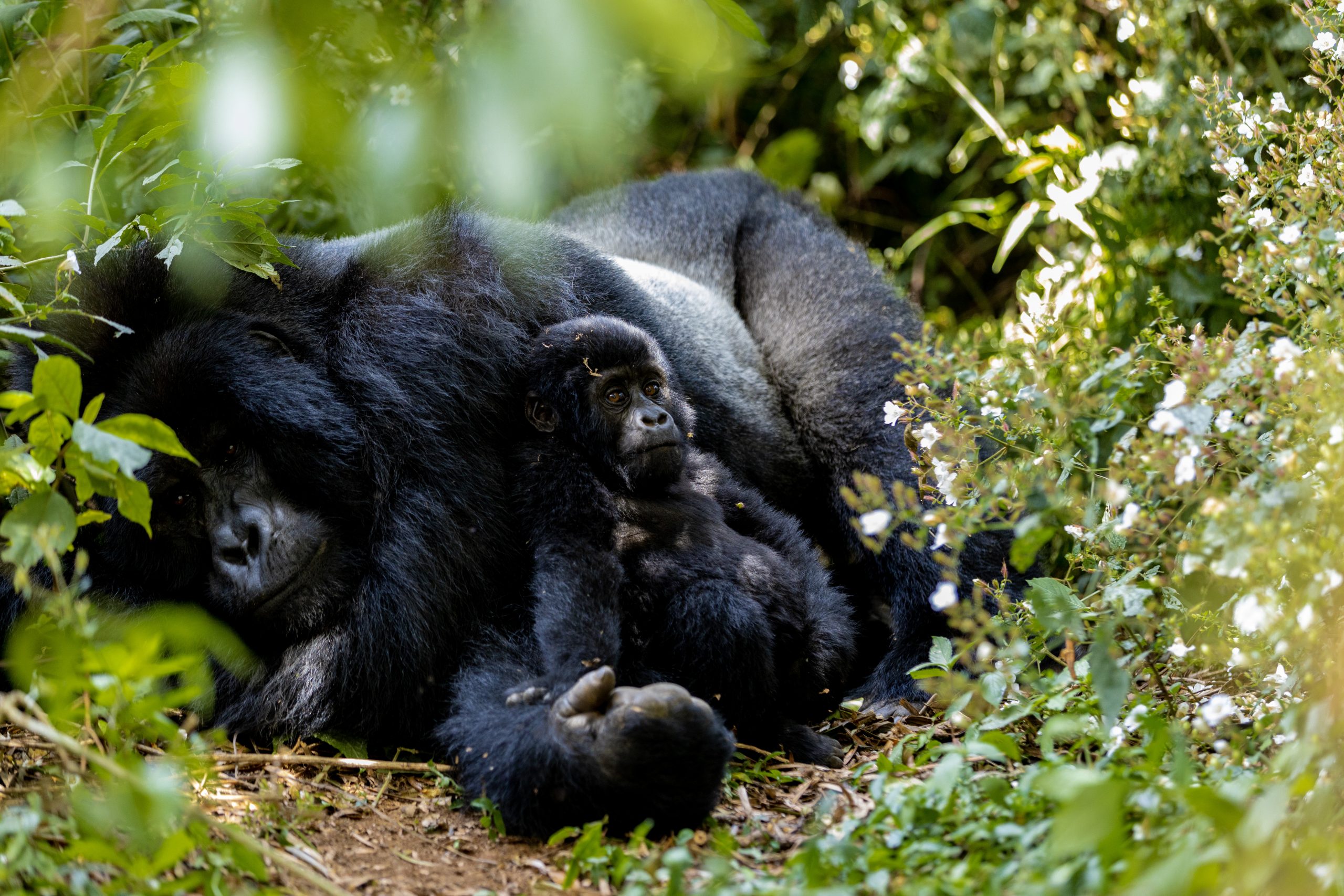
Mountain gorillas have longer hair and tend to be more grey than brown. Their faces are more densely covered in hair. They are also a little bit bigger. Their family structures resemble a harem, with one or a small number of dominant males and a stable group of females. Other gorillas live in less stable family structures and group composition and group size changes much more frequently.

Which gorillas do you see in zoos?

All the gorillas in zoos are lowland gorillas. Most of them are actually western lowland gorillas (see Great apes).
How can I visit the gorillas?
Many tour operators provide trips to visit the gorillas in Uganda and Rwanda. For a comprehensive list, download the PDF from the library page. Only a small number of people can visit the gorillas each day, so it is important to book gorilla permits well in advance. Visiting the gorillas can be physically strenuous, so visitors must be moderately fit and suitably equipped for walking on forested mountain trails.

How safe is it to visit the gorillas?

The gorillas are not aggressive and rarely react to the visitors, let alone behave in a threatening manner. Tourists must follow strict rules in order to minimize the risk of disease transmission (from human to gorilla!) and avoid causing stress to the animals (see Tourism). A twisted ankle, sustained during a heavy fall on the steep trails, is a far more likely occurrence than an injury resulting from a gorilla encounter.

Rwanda and Uganda are safe destinations, and gorilla tourism is on the increase. For the most up-to-date travel advice, we recommend that you visit your embassy’s website.

faq

Find out more about Gorillas

  • If you value the natural world, if you believe it should be conserved for its own sake as well as for humanity’s, then please lend your support

  • — Sir David Attenborough
Latest news & posts
  • Documenting the Families of Volcanoes National Park

    Documenting the Families of Volcanoes National Park

    The puffy white clouds were morphing to gray as we stood in front Sabyinyo Volcano’s knotty peaks.  As they are want to do, they started creeping towards the mountain’s spine.  I knew that in an hour or two they...

    Read more
    Employment Opportunity with IGCP: Communications Officer

    Employment Opportunity with IGCP: Communications Officer

    The International Gorilla Conservation Programme (IGCP) invites applications for the post of Communications Officer, who will partner with IGCP staff to create and manage communications and media activities.  The...

    Read more
    Groundbreaking Gathering Seeks to Probe the Impacts of Climate Change on the Highly Endangered Mountain Gorilla

    Groundbreaking Gathering Seeks to Probe the Impacts of Climate Change on the Highly Endangered Mountain Gorilla

    12 February 2010 - How is climate change impacting the mountain gorilla and its conservation?  This question will be investigated in the first organized workshop focusing specifically on the relationship between the...

    Read more
    Trekking at the Intersection of Climate Change and Gorilla Conservation

    Trekking at the Intersection of Climate Change and Gorilla Conservation

    The sense of stillness, clarity and peace are overwhelming as we approach the Gikeri patrol post.  Fat fields of beans, cabbage and sweet potatoes stretch out in all directions, invoking a green carpet of bounty that...

    Read more
  • Highly Endangered Mountain Gorilla to Get Counted in Vital Census

    Highly Endangered Mountain Gorilla to Get Counted in Vital Census

    The critically endangered mountain gorilla’s current status is to be revealed through a census to determine its population size in the Virunga Volcanoes area that straddles the borders of the Democratic Republic...

    Read more
    Building a Future in Bukima

    Building a Future in Bukima

    Goma bustles.  Goma hustles.  Goma tussles with poverty and the effects of a devastating decade plus war in this resource rich sector of Eastern Democratic Republic of Congo, whose dying flame stubbornly refuses to be...

    Read more
    Walking Under the Volcanoes’ Shadow with the Batwa

    Walking Under the Volcanoes’ Shadow with the Batwa

    The moss drips from the trees surrounding the camp in a filigree of light and delicate wisps of the bright green and earthy chocolates of the rainforest.  We sit on a bamboo bench with the smoking shacks in front of us...

    Read more
    Twins! A Baby! A Community on the Move!

    Twins! A Baby! A Community on the Move!

    Wobbling down what seems like an endless descent from the lofty perches of Nkuringo Ridge, the village of Kahurire in the patchwork of green hollows below looks tiny no matter how close we get to it, like a scattering...

    Read more